How to get found in local searches – This should be your top priority
Customers Are Already Looking for You
These customers should be your top marketing priority.
Every day, people search online for local businesses that offer the products and services they’re looking for..
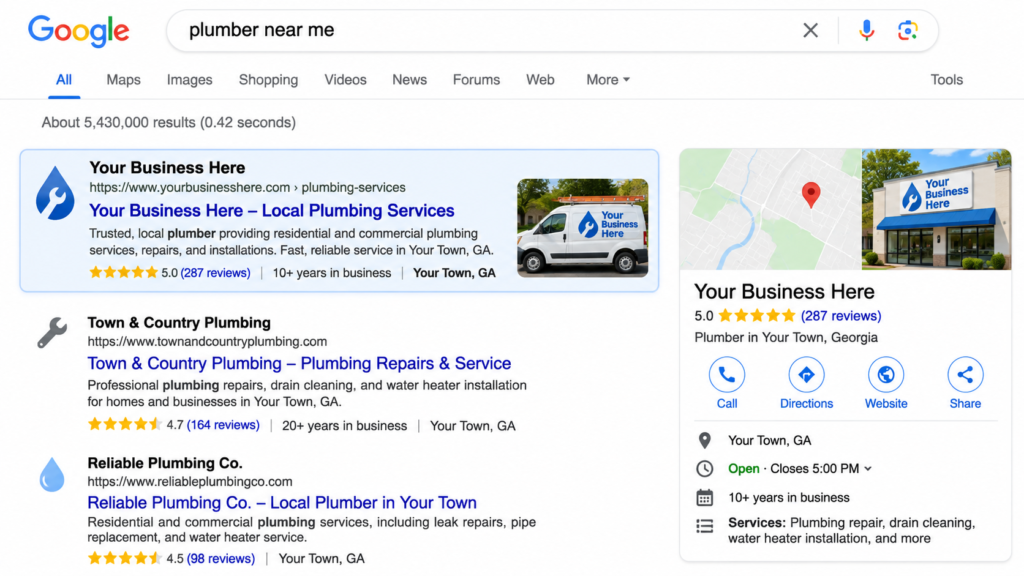
Someone needs a plumber to repair a leaking pipe. A homeowner is looking for a roofing contractor. A driver needs new tires. A small business owner is searching for a local accountant.
These people aren’t browsing advertisements or waiting for a business to contact them. They’re actively searching for someone who can help them.
The question is: Will they find your business?
Welcome to They’re Searching For You Now, an educational blog from In The South Media LLC. Our purpose is simple: to help small business owners understand how to make their businesses easier to find when potential customers search online.
1. Who Is This Blog For?
This blog is for small business owners who want more customers to discover their businesses through online searches.
You don’t need to understand search engine optimization (SEO), website development, or the technical details of how Google works.
You might own an auto repair shop, a plumbing company, a law firm, a retail store, or any other business that serves customers in a particular community.
You probably already have a website. You may have a Google Business Profile and a few social media accounts. But are those assets doing everything they can to help potential customers find you?
That’s what we’re here to help you understand.
We’ll explain the different ways your business can appear in search results and what you can do to improve its visibility.
Our goal is to make local search optimization understandable and practical for everyday business owners.
2. What Will You Learn?
Getting found online involves more than simply having a website.
Search engines use information from many different sources to determine which businesses to display when someone searches for a product or service.
Your website is one source. Your Google Business Profile is another. Customer reviews, business directories, photographs, videos, and information published on other websites can also contribute to your online visibility.
And now, artificial intelligence is changing how people search for businesses.
Customers can ask AI-powered search tools questions such as, “Who installs water heaters near me?” or “Where can I find a reliable auto repair shop in my area?” or the common question “Best plumber near me”.
These tools may generate answers that mention specific businesses and link to sources of information.
Throughout this blog, we’ll explore topics such as:
- Website optimization: How individual pages describing your products and services can help search engines understand what your business offers.
- Google Business Profile optimization: How to improve the information that appears about your business in Google Search and Google Maps.
- Local business listings: Why accurate information on Bing, Apple Maps, and relevant business directories matters.
- Customer reviews: How reviews can influence customer decisions and contribute to local search visibility.
- AI-powered search: How to make your business information easier for AI search systems to discover, understand, and reference.
- Images and videos: How photographs and videos of your products, services, and completed projects can create additional opportunities to be discovered.
- Social media search visibility: How publicly available social media content can help people find information about your business through search.
- Search performance: How to use free tools to see whether your business is appearing in search results and what people are searching for.
Each of these topics represents an opportunity to improve how your business is discovered online.
3. What Won’t We Cover?
There are many ways to market a small business, but this blog has a very specific focus.
We’re interested in helping customers find your business when they’re already searching for what you offer.
We won’t be covering paid advertising campaigns, social media advertising, or strategies designed primarily to gain followers, likes, and shares.
Those approaches have their place, but they aren’t the purpose of this blog.
For example, we may explain how to create a Facebook post that answers a question people commonly search for online. But we won’t be discussing how to boost that post with paid advertising or how to increase its engagement.
The difference is important.
Traditional advertising attempts to put your message in front of people, whether they’re currently interested in your services or not.
Search optimization focuses on helping your business appear when someone is already looking for information, products, or services related to what you offer.
That’s where we’ll concentrate our efforts.
4. How Will We Present the Information?
We’re going to keep things straightforward.
Each blog post will focus on one specific asset, feature, or technique that can help improve your business’s search visibility.
We’ll explain what it is, why it matters, and how you can put it to work.
For example, one article might explain why a plumbing company should have a separate website page for water heater installation rather than simply listing that service on its homepage.
Another might walk through choosing the most appropriate categories for a Google Business Profile.
A third might explain how AI-powered search systems find information about local businesses and what you can do to make your business information more accessible.
Whenever possible, we’ll include practical examples and steps you can follow yourself.
We’ll also explain common mistakes to avoid and how to determine whether your efforts are producing results.
You won’t need to become an SEO expert to benefit from this information.
And we won’t promise that following a particular step will put your business at the top of Google. Search rankings depend on many factors, including competition, relevance, and location.
Our objective is to help you make informed improvements that give your business more opportunities to be discovered.
5. SEO Isn’t an Activity; It’s a Process.
Think of search engine optimization the same way you think about diet and exercise.
If you want to improve your physical fitness, you can’t go to the gym once, eat a healthy meal, and expect lasting results.
You need to develop good habits, follow a consistent routine, monitor your progress, and make adjustments along the way.
Some exercises will produce better results than others. You may need to change your diet, increase your activity, or adjust your routine as your fitness improves.
And if you stop exercising and abandon your healthy habits, you may eventually lose some of the progress you’ve made.
Search engine optimization works much the same way.
Creating a website, setting up a Google Business Profile, or publishing a few blog posts are good starting points. But they aren’t the finish line.
Improving your visibility in local searches requires consistent attention and ongoing improvements.
For example, suppose you own an auto repair shop.
You create a website page describing your brake repair services. Over time, you discover that potential customers are also searching for information about brake pad replacement costs and warning signs of worn brakes.
You can improve your existing page or create additional content that answers those questions.
You might also discover that your Google Business Profile isn’t generating as many calls as you expected. After reviewing your profile, you realize that several services aren’t listed and your business photographs are outdated.
You update the information, add photographs of your shop and services, and continue monitoring the results.
Or perhaps you notice that a competitor consistently appears in searches for a service you provide. By reviewing the search results and comparing the information available about both businesses, you may identify opportunities to improve your own website content or business listings.
The key is to keep learning from the results and making informed adjustments.
Just as you might track your weight, strength, or endurance when following an exercise program, you should monitor your business’s search performance.
Free tools such as Google Search Console and Google Business Profile performance reports can help you understand how people discover your business online.
You can learn which search terms are bringing people to your website, which pages appear in search results, and how customers interact with your business profile.
This information helps you decide what to improve next.
And remember, results don’t always happen immediately.
Just as a week of exercise won’t transform your physical fitness, a few website improvements won’t necessarily produce an immediate increase in search rankings.
Search engines need time to discover and evaluate changes. Competitors are making improvements, too. Search behavior changes, and search engines continually update how they present results.
That’s why consistency matters.
You don’t need to make major changes every day. Even small, well-planned improvements made regularly can strengthen your business’s online presence over time.
The most effective approach is a continuous cycle:
Evaluate: Review how your business currently appears in search results.
Improve: Make specific changes to your website, business profiles, or other search-related assets.
Monitor: Track relevant search performance to see what changes.
Adjust: Use what you learn to refine your approach and identify the next opportunity.
Repeat: Continue the process as your business, competitors, and search technology evolve.
Not every adjustment will produce better rankings, and some results will take time to evaluate. But regularly reviewing performance and making thoughtful improvements gives you a much better foundation than treating SEO as a one-time project.
SEO isn’t something you do once and check off your to-do list. It’s an ongoing process of improvement.
And just like diet and exercise, the businesses that develop consistent habits are better positioned to see meaningful results over the long term.
When someone in your community searches for your product or service, my goal is to help you be the one they find..
That’s what They’re Searching For You Now is all about.
We’ll explore the tools, techniques, and digital assets that help small businesses become more visible in local search results.
One topic at a time. In plain language. With practical information you can use.
No advertising strategies. No complicated marketing jargon. Just useful information about helping potential customers find your business.
They’re searching for you now let’s help them find you.
They’re Searching For You Now is published by In The South Media LLC, helping small businesses understand and improve their visibility in local online searches.