Why ranking in Google’s top three results isn’t the only way to get noticed in local searches.
Your Business Has More Opportunities to Be Found Than You Might Think
When someone searches Google for a local product or service, what do they see?
You might assume Google simply displays a list of websites, ranked from the most relevant to the least relevant.
Years ago, that was a fairly accurate description. Today, a Google Search results page can contain advertisements, business listings, maps, AI-generated answers, website links, customer reviews, videos, questions, and information from other online sources.
Each section creates a different opportunity for a potential customer to discover your business.
For example, imagine someone searching for “brake repair near me.”
Google might display three local auto repair shops with their ratings and locations. It could also show an AI-generated explanation of brake repair costs, a YouTube video about worn brake pads, a business directory listing, and websites offering brake repair services.
Your business doesn’t necessarily have to appear in the top three organic website results to be discovered.
It could appear in the local business listings, be mentioned in an AI-generated answer, or be discovered through another website that Google includes in its results.
Understanding these opportunities is the first step toward making your business easier to find.
Let’s examine the different sections of a Google Search results page, where their information comes from, and how your business might appear in them.
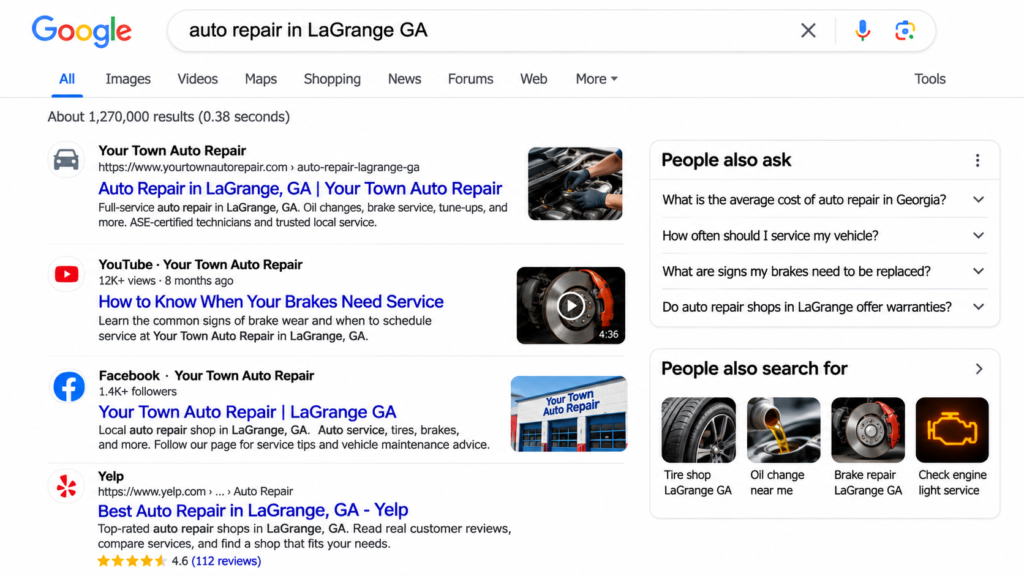
1. Sponsored Results: Paid Positions in Google Search
Sponsored results are advertisements that businesses pay Google to display.
They may appear near the top or bottom of the search results page and are identified with a label such as “Sponsored.”
For example, when someone searches for “emergency plumber near me,” a plumbing company might pay to have its advertisement displayed for that search.
Google determines which advertisements appear through an advertising auction that considers factors such as bids, advertisement quality, and relevance.
How does a business appear here?
Businesses participate through Google Ads, creating campaigns that target particular searches, locations, or customer needs.
Sponsored results can provide visibility, but they aren’t organic search rankings. Paying for an advertisement doesn’t improve a business’s position in Google’s unpaid results.
Our approach: At In The South Media, our focus is on helping businesses become easier to find through unpaid search results. We’ll explain sponsored results so you understand what you’re seeing, but paid advertising isn’t the subject of this blog.
2. Local Business Results: The Google Maps Local Pack
One of the most valuable sections for local businesses is the group of business listings often called the Local Pack or Map Pack.
For searches such as “auto repair near me” or “roofing contractors in LaGrange,” Google may display a map accompanied by a small group of businesses, often three.
These listings can include:
- Business names and categories
- Customer ratings and reviews
- Business hours
- Addresses and service areas
- Photographs
- Directions, phone numbers, and website links
This section is especially valuable because potential customers can often contact a business without visiting its website.
Where does this information come from?
Much of the information comes from Google Business Profiles, supplemented by information Google gathers from websites, customers, and other sources.
Google primarily evaluates three factors when ranking local businesses:
Relevance: How closely the business matches the search.
Distance: How far the business is from the location associated with the search.
Prominence: How well-known and established the business appears to be, based on signals such as reviews, links, and other information.
How can your business appear here?
Start by claiming and verifying your Google Business Profile, if eligible.
Choose accurate business categories, describe your services, maintain correct contact information and hours, add relevant photographs, and develop a consistent process for requesting genuine customer reviews.
A complete, accurate profile helps Google understand your business and gives potential customers more useful information.
Remember that local rankings vary depending on the searcher’s location. A business might appear in the top three for someone searching nearby but rank differently for someone across town.
The opportunity: Your business can appear prominently in Google Maps results even when your website isn’t among the top three organic website listings.
3. AI Overviews: When Google Answers the Question
Google increasingly uses artificial intelligence to generate answers to certain searches.
These responses are called AI Overviews.
For example, someone might search:
“How do I know if my car needs new brake pads?”
Google may display an AI-generated explanation describing common warning signs, approximate maintenance considerations, and links to supporting websites.
AI Overviews don’t appear for every search, and the information they display varies.
Where does the information come from?
Google’s AI systems use search technologies and information from web sources to develop responses. Some answers include links to websites that support or expand on the information presented.
These supporting links create another opportunity for businesses to be discovered.
How can your business appear here?
Suppose your auto repair shop publishes a helpful article explaining the warning signs of worn brake pads.
Your article might answer questions such as:
- Why do brakes squeal?
- How long do brake pads last?
- What are the signs of worn brake pads?
- When should brake pads be replaced?
If Google can crawl and index the article and determine that it’s a useful source for a particular search, the page may be eligible to appear as a supporting link in an AI Overview.
There is no guaranteed technique for inclusion. Google recommends the same fundamental SEO practices used for traditional search: helpful original content, clear information, and technically accessible web pages.
The opportunity: A useful article from a local business may be discovered through an AI-generated answer, even if the business isn’t among the top three traditional website results.
4. Organic Website Results: The Traditional Search Listings
These are the familiar website listings that have been part of Google Search for years.
Each typically includes a website name or address, a clickable title, and a short description of the page.
Unlike sponsored results, businesses don’t pay Google for their organic positions.
Where do these listings come from?
Google uses automated systems to discover web pages, process their content, and determine which pages are most relevant and useful for particular searches.
For example, if someone searches for “brake repair in LaGrange GA,” Google may display individual service pages from local auto repair shops.
A website with a dedicated brake repair page may provide a more useful answer than a general homepage that barely mentions brake services.
How can your business appear here?
Create useful, keyword-focused pages that clearly describe the products and services your business offers.
That includes individual service pages, product pages, helpful articles, frequently asked questions, and location information where appropriate.
Use descriptive page titles, meaningful headings, internal links, and accurate information that answers what customers are searching for.
The opportunity: Every relevant, well-developed page on your website represents another potential entry point from Google Search.
And ranking fourth, fifth, or sixth can still bring visitors to your website. The top three positions are highly desirable, but they aren’t the only positions with value.
5. Results From Other Websites: Directories, Citations, and Industry Listings
Here’s an opportunity many small business owners overlook.
Not every Google result needs to link directly to your website.
Sometimes Google displays pages from business directories, review platforms, professional associations, and other third-party websites.
Examples include:
- Yelp and other business review platforms
- Better Business Bureau profiles
- Local Chamber of Commerce directories
- Professional association directories
- Industry-specific business listings
- Manufacturer authorized-dealer directories
- Local newspaper business directories
- Community and regional business websites
Imagine someone searches for “best auto repair shops in LaGrange.”
Google might display a Yelp page listing several auto repair shops in the area.
Even if your shop’s website doesn’t appear among Google’s top results, a potential customer could discover your business by opening that directory page.
Where does this information come from?
These websites maintain their own business listings and content. Some information is supplied by business owners, while other information may come from public records, customers, or data providers.
Google evaluates and ranks the directory pages just as it evaluates other web content.
How can your business appear here?
Claim and complete relevant business directory profiles.
Make sure your business name, address, phone number, website, and service information are accurate and consistent.
Prioritize directories that are legitimate and relevant to your business or community.
These listings are sometimes called local citations, especially when they mention your business’s identifying information.
The opportunity: A third-party website can become another pathway for customers to find your business, even when your own website isn’t highly ranked.
6. Social Media Results: Search Visibility Beyond Your Website
Google can also display publicly accessible social media profiles, posts, and videos.
Depending on the search, results may come from Facebook, Instagram, LinkedIn, YouTube, TikTok, Pinterest, or other platforms.
For example, a landscaping company might publish a public video explaining how to recognize lawn drainage problems.
Someone searching for “how to fix standing water in my yard” could discover that video through Google or the video platform’s own search results.
Where does this information come from?
Google can discover and index eligible public content from social platforms. Whether it appears depends on the content, platform accessibility, search relevance, and Google’s ranking systems.
Not every public post will be indexed or displayed.
How can your business appear here?
Maintain accurate business profiles and publish useful, publicly accessible content related to your products and services.
Use descriptive titles, captions, and explanations that reflect the questions your customers ask.
The objective isn’t to collect likes or followers. It’s to make useful information about your business discoverable.
The opportunity: Your business can be discovered through searchable social media content without buying advertising or depending on a large following.
7. People Also Ask: Questions Your Customers Are Already Asking
Google frequently displays a section called People Also Ask.
This section contains questions related to the original search.
For example, someone searching for “brake repair” might see questions such as:
- How much does a brake repair usually cost?
- How do I know if my brakes need replacing?
- Can I drive with worn brake pads?
- How long does a brake repair take?
When someone opens a question, Google may display a short answer taken from a website, along with a link to the source.
Where do these questions and answers come from?
Google automatically generates related questions based on the search and other signals.
The answers are selected from web content that Google’s systems determine is useful for addressing those questions.
How can your business appear here?
Publish clear, helpful answers to questions your customers frequently ask.
For example, an auto repair shop could create an article titled “Five Warning Signs Your Brake Pads Need Replacing.”
Use descriptive headings and explain each topic in straightforward language.
Google determines which questions and sources appear, so inclusion isn’t guaranteed.
The opportunity: A business’s educational content can appear in a question-and-answer search feature, giving potential customers another way to discover its website.
8. People Also Search For: Discovering Related Searches
Google also suggests related searches that help users explore a topic further.
These suggestions may appear under headings such as People also search for or Related searches.
For example, someone searching for “brake repair near me” might see suggestions involving:
- Brake pad replacement cost
- Brake rotor replacement
- Brake inspection services
- Emergency brake repair
- Brake repair shops open Saturday
These suggestions can lead customers to entirely new search results pages.
Where do these suggestions come from?
Google generates related searches using information about the original query and broader search behavior.
How can your business benefit?
Unlike a standard website listing, you can’t directly submit your business to appear inside these search suggestions.
Instead, you can use them to discover related topics that customers care about.
If people frequently search for brake rotor replacement, that may be a good reason to create a detailed service page explaining your shop’s rotor replacement services.
If customers ask about brake repair costs, consider publishing a useful pricing explanation.
The opportunity: Related searches help you discover additional keywords, services, and questions that can guide your website content strategy.
9. Other Google Search Features Worth Understanding
Depending on the search, Google may display additional features that create opportunities for local businesses.
Featured snippets: Short answers or excerpts selected from web pages and displayed prominently in search results.
Image results: Photographs and graphics from websites and other sources, particularly useful for businesses with visual products or completed projects.
Video results: Relevant videos from YouTube and other eligible websites, including demonstrations, tutorials, and service explanations.
Knowledge Panels: Information panels about recognized businesses, organizations, and other entities, assembled from sources Google considers relevant.
Product and shopping results: Product information, images, prices, and merchant listings, including eligible unpaid product listings.
Reviews and ratings: Rating information displayed within eligible business listings and certain search features.
Top stories and news results: Articles from news publishers, which may provide visibility for businesses mentioned in relevant local reporting.
Events: Event listings that may appear for eligible public events with appropriate online information.
Sitelinks: Additional links displayed beneath certain website results, helping searchers navigate directly to important pages.
Not every feature appears on every search results page. Google selects the layout and features based on the search query, device, location, and other factors.
The important point is that Google Search is no longer just a ranked list of ten websites. It’s a collection of different ways people can discover information and businesses.
10. Why the First Page Matters, Even When You’re Not in the Top Three
Let’s talk about why search rankings matter.
The highest organic positions generally attract more clicks than lower positions. That’s one reason businesses work so hard to reach the top.
But lower positions on the first page can still attract meaningful traffic.
For example, research published by Backlinko has reported an average click-through rate of approximately 27.6% for the first organic result, compared with approximately 8.4% for the fourth position.
That means the top position is considerably more valuable on average, but the fourth position can still attract visitors.
Consider a simplified example.
If a particular search produces 1,000 impressions of your website listing, an 8.4% click-through rate would translate into approximately 84 website visits.
Those visits could include potential customers looking for exactly what your business offers.
These figures are averages from a particular study, not predictions for an individual business. Actual click-through rates depend on the search, location, competition, device, and features displayed on the results page.
The numbers also don’t fully capture the value of Google Maps listings, AI-generated answers, or other search features.
A customer might call your business directly from its Google Business Profile without ever visiting your website.
Another might discover your business through an industry directory or a video.
That’s why measuring search visibility requires looking beyond traditional website rankings.
The top three positions are valuable goals, but there are meaningful opportunities elsewhere on the results page.
11. In The South Media’s Goal: Get Found First, Then Keep Improving
At In The South Media LLC, we believe local search optimization should be approached as a continuous process.
Our objective is straightforward:
Help your business earn visibility anywhere relevant on the first page of Google Search, then continuously work toward stronger positions, including the top three results.
That doesn’t mean every business can immediately reach the first page for every keyword. Competition, location, relevance, and other factors influence rankings.
It means we look for multiple opportunities rather than concentrating exclusively on a single website ranking.
For example, an auto repair shop might initially struggle to rank on the first page for “auto repair near me.”
But it may have opportunities to:
- Improve its Google Business Profile and local map visibility.
- Create a dedicated brake repair page targeting a more specific search.
- Appear in a relevant local business directory.
- Publish helpful articles answering common automotive questions.
- Create searchable videos explaining repair services.
- Develop useful content that may be referenced in AI-generated answers.
Each of these represents a different way to become discoverable.
Some may produce results sooner than others. Some may be more valuable for particular services or search terms.
Our approach is to identify the most promising opportunities, make improvements, measure the results, and continue adjusting.
SEO Isn’t an Activity; It’s a Process
Just as we explained in our introductory article, search engine optimization is much like diet and exercise.
You don’t exercise once and expect permanent results.
You develop consistent habits, monitor your progress, and adjust your routine as you learn what works.
SEO requires the same commitment.
We evaluate how a business currently appears in search results, identify opportunities for improvement, make targeted changes, and monitor performance.
Then we repeat the process.
A page ranking eighth might eventually move to fifth. A service page ranking fifth might improve to third. A business that isn’t appearing in relevant map results might gain visibility after improvements to its business information and online presence.
Progress isn’t always steady, and rankings can move in either direction. But consistent monitoring helps us understand what’s happening and decide what to improve next.
The first page is an important milestone. The top three is a valuable objective. Continuous improvement is the process that connects them.
12. Start Looking at Google Search Differently
The next time you search Google for a product or service your business offers, don’t look only at the first three website listings.
Examine the entire results page.
Notice the local business listings, AI Overviews, directory results, videos, customer questions, and related searches.
Ask yourself:
“Where could my business appear on this page?”
That question can reveal opportunities you may have never considered.
You might discover that your business needs a better Google Business Profile, a more detailed service page, an updated directory listing, or an article answering a question customers frequently ask.
Each improvement is another step toward helping potential customers find you.
At They’re Searching For You Now, we’ll explore these assets and techniques one at a time, explaining what they are, why they matter, and how you can use them to improve your business’s visibility.
Because your next customer may already be searching for what you offer. Let’s make sure they have more opportunities to find you.
They’re Searching For You Now is an educational blog published by In The South Media LLC, helping small businesses understand and improve their visibility in local online searches.